Can We Forbid Clothing?

In Muslim culture today, men and women are still being instructed on what to wear. Whereas the majority of today’s population is free to dress as they please, the Muslim religion implements a strict dress code onto individuals who still abide by it. These individuals, for example, are not allowed to wear clothing from the opposite sex, nor are they supposed to reveal too much skin in the presence of strangers. Whereas it is the 21st century and we, as a society, have advanced towards a much more liberal dress code, no particular clothing item should be banned because these people are following a particular religion and dressing according to their beliefs.
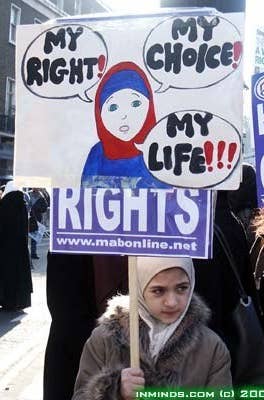
Women protest against laws that target hijabs and niqabs. 

Due to the fact that citizens of the United States are granted free will and equality, we should be respectful towards others’ choices of clothing and beliefs. Many Muslims, for example, dress the way they do because of the religion that they follow. As explained in the article, “Clothing from an Islamic Perspective,” Muslims are most often advised to pay more attention to what they wear in comparison to other Western individuals– this is due to the fact that Islam is “a religion which lays down rules based on the dictates of the pure nature innate in all humans: straightforward reasoning and sound logic” (“Clothing from an Islamic Perspective”). As a result of these ideals, Muslims tend to dress the way they do because they believe in modesty, purity, and maintaining the original forms of human nature. Therefore, in concealing private parts and such, they would be be retaining their modesty and morals as directed by Allah.

Another point regarding what clothing should be worn is the fact that Muslims are not to dress with pride. This is because pride can be seen as a negative and selfish aspect so therefore, people are to dress according to their social statuses. Overall, “notorious clothing due to loud and repulsive color… makes its wearer an object of pride and fame, attracting too much attention to himself” (“Clothing from an Islamic Perspective”). These requirements of dress code for Muslims also act to further reinforce the idea of modesty.

Whereas many people in today’s society encourage a much more liberal way of dress without restricting clothing items, people are still free to wear what they want. Muslims, in this case, dress the way they do because they have chosen to abide by a particular religion that implements a certain dress code– therefore, we are not ones to advise them what they can or cannot wear.

“Friendly Fire”

Collateral damage, also referred to as “friendly fire,” is the casual term for unintentional deaths or injuries of another party during a particular event. Commonly used as a war term, however, “collateral damage” specifically refers to the incidental damage of property and wounding/killing of citizens during an attack that is originally directed at a military target.

Too often has this term been used as a way to frame and even conceal the brutality of war. Because the connotation behind “collateral damage” means unknowing, unintentional, or unavoidable, attackers seem to get away with the killings or the harm that they have inflicted upon innocent citizens. This term, therefore, masks the cruelty of these actions, and even excuses them, by calling it damage– not murder.

One prime example of collateral damage occurring in a war is the attack of Pearl Harbor on December 7, 1971. In a surprise attack, hundreds of Japanese fighter planes bombed the military base of the U.S. in Hawaii, causing a total of 2000 American soldier deaths and wounding approximately 1000 others (“Pearl Harbor,” 1).

Whereas the attack was very fatal to the American military, it also left immense impact on civilians across the island. A total of forty nine bystanders were killed and another thirty five were wounded in the event. Several civilians were working in sugar mills at the time and nearby docks when mistaken bombs were dropped by the Japanese.

Other civilians were much more inland, but still affected by the attack. As Japanese bombers crashed their planes and landed in non-war territory, they began terrorizing and looting the inhabitants. In other cases, Japanese aircraft failed to “detonate properly and landed in civilian areas around Pearl Harbor and Honolulu, exploding on contact with the ground” (“Pearl Harbor,” 1). Even to this day, some bombs and mines have yet to explode, but are still buried deep into the soils of the island. This exposes farmers and other civilians to the risk of accidentally coming into contact with these weapons, and having them detonate.

The attack on Pearl Harbor was never intentionally directed at Honolulu’s citizens, but at the American naval base instead. Unfortunately, the attack released a series of bombs that exploded in nearby villages, fields, and mills. This unexpected, yet unavoidable, attack by the Japanese also heavily hurt civilians who had no direct role in the war.  By coining these deaths as “collateral damage,” Japanese bombers, and other attackers, seemingly get away with killings that they have never morally, or consciously, intended to commit.

Power of the Powerless

The debate on how to maintain power in our communities despite one’s position has been quite a prominent one in a majority of societies. Because of the social hierarchy that exists, many people still struggle for representation, equality, or some form of acknowledgment regardless of their status. Therefore, as ironic as it seems, it is possible for someone to be powerless in a powerful position or even powerful in a powerless one.

As described in Keltner’s article, this imbalance of power can be referred to as a “power paradox.” According to paradox, we possess the abilities to gain power and heavily influence others when we are in a leadership position. Unfortunately, even once we gain this success, we can lose that support from others and be left “vulnerable to impulsive, self-serving actions… that set in motion our fall” (Keltner). This definition of the power paradox is accurate in that it shows how a dictator (or leader) can be weaker than the people whom he/she is ruling over.

As a leading figure in a community, that individual is automatically placed at an advantage relative to the rest of the people. He becomes much more well-known, and his ideals are easily spread with the help of the media. Unfortunately, being a leader also requires a lot of responsibility– he/she is expected to appeal to multiple differents groups of people while not showing favoritism towards any certain one. This is especially difficult in multicultural countries such as the U.S. No longer do leaders only implement beliefs that best suit their ideals– instead, they must face the demands of different ethnic and cultural groups, and implement laws that compromise with the majority’s needs instead. A leader, therefore, can be seen as weak in this position because he is required to comply with his subjects’ needs more than his own. Therefore, the leader’s power is not only defined by his own, but by how much support he is able to gain from the people– without them, he would be powerless.

To further emphasize this point, a situation such as this one can be reversed to show how ordinary citizens are also powerful in a powerless position. In contrast to dictators and higher officials, an individual by him or herself is undoubtedly weaker. Their opinions are not so easily voiced and these people somewhat just blend into the crowd. However, a union of voices empowers the citizens and even allows them to stand up against unjust leaders. Although these citizens do not have legitimate authoritative positions, they are powerful in that they can shape a ruler’s actions and what sorts of laws he/she implements. Due to this, a ruler must comply with others to maintain power– if he does not, the people join forces and become powerful enough to stand up to an unjust leader.

Overall, there is a balance of power maintained between a leader and his citizens in many societies. A ruler’s capacity of influence is dependent on how much he values his subjects’ needs– therefore proving how one can be both powerful and powerless regardless of his or her social standing.

How We Have Divided Ourselves

Following the results of the 2016 presidential election, America is more racially divided than it has been for years. This social divide could have existed for sometime now, but the outcome of the election makes way for a formal representative  who actually encourages these ideas. America’s new president, Trump, has created a distinctive line between different ethnicities, and shrouded the country with some of the most backwards and conservative beliefs.

Even before Trump had been elected president, America was already socially divided by its racial classes and diverse range of ethnicities. White supremacy, the discrimination of minorities, islamophobia, etc. were all prominent factors that caused tension amongst the communities; therefore we cannot actually blame Trump for introducing these ideas upon his presidency. What he is at fault for, however, is the fact that he further instills these fears into our minds– not so that we become socially aware of one another, but so that we turn on each other even more and eventually drive away minority groups. All in all, Trump’s slogan “Make America Great Again” means shaping America into a country of pessimistic and racist ideals.

Trump’s most recent executive order, which is his travel ban, caused quite an uproar at multiple airports starting January 27th, 2017. In short, the ban kept “refugees from entering the country for 120 days and immigrants from seven predominantly Muslim nations out for three months” (Criss, 1). Some of the countries that Trump banned included Iran, Iraq, and Syria (for purposes of Islamophobia).  Not only were immigrants and refugees prevented from entering the U.S., people who appeared “suspicious” because of their ethnicities (but actually held valid visas) were detained and not permitted to re-enter the country.

The overall fact that Trump won the presidency in the first place and managed to pass such an outrageous order only emphasizes the racial tension that has always divided our social classes. As citizens having previously lived in a multicultural/ liberal country, we were not always aware of the racism and ethnic fears that were out there. Once Trump became president, however, our country grew even more divided as he instilled new fears within us. Americans who were already against diversity grew stronger and more influential with their new representative, whereas others began fearing each other. Overall, Trump’s presidency has negatively impacted us as citizens by drawing distinctive divides between the social classes and encouraging racism towards those unlike us.

The Values of the Western World

“Life, liberty, and the pursuit of happiness”– these are the core values that America had been founded upon. Although the U.S. only makes up about half of the Western world, other countries such as Europe, also embody similar beliefs pertaining to liberty and equality. Overall, the West differs from the East in that Westerners have been raised to embrace individuality and to live life to its fullest potential.

The majority of Western values happen to have the notions of equality and freedom incorporated into them. For example, the freedom of speech and practice of religion is a given in the Western world. The government has no right to impose on people’s values as long as the values do not become inappropriate, demeaning, and harmful– otherwise, citizens in both America and Europe are granted the right to express ideas as they please. The freedom of religion also protects individuals from having other religious beliefs imposed on them. The government, in this case, is not allowed to favor a particular religion or have public schools impose religious beliefs on anyone. Due to this, most people generally mind their own practices; there are fewer violent outbreaks due to resistance or enforcement of a particular religion (“Teaching Tolerance,” 1).


Other values include the encouragement of personal development and self-identity. Unlike the Eastern side of the world, Westerners are brought up under a very individualistic belief system. This does not mean that they are selfish and only think of their own self-benefits– rather, these people strive for personal goals instead of ones that would have to benefit a collective group (Dhar). In modern day society, people are more often allowed to embrace themselves for who they are, whether that concerns their sexuality, gender, relationship, etc. Easterners, on the other hand,  live in a more conservative society in which, unfortunately, it is not always safe for one to express his/her true sexuality/gender. They also have the tendency to marry out of benefits for the larger family than out of love.  

The fact that Western society urges individuality and the freedom of expression is what allows this side of the world to become so diverse and unique. Over time, people begin to accept one another more often as they become accustomed to everyone’s differences. Also, when these differences are allowed, there are fewer outbreaks of oppression or violence. Overall, the sorts of freedoms we are granted enable us to become more open-minded in our communities while still growing together.

The Progression of Our Education System

As mentioned in one of my earlier blog posts, the issue of a corrupted education system has significantly contributed to further division and racial segregation in our communities over the years. When discussed previously, education was said to have caused this by latently training and pushing students towards financial competition as adults. However, there are also other reasons as to why education has caused such a separation in our society and also a setback in our country– these include the bias in what is being taught and to whom it is being taught.

Censorship and bias in education has been a controversial, yet widely-debated topic in America. To be put simply, these two factors are the removal of certain topics and evidence in American history because of them being too violent and damaging to our minds. Apparently, these truths ruin our impressions  of American nationalism with its exposure of our country’s historically cruel deeds (“Censorship in Schools and its Effects on Our Children”). For example, history textbooks rarely convey, in full detail, the torture methods used on African Americans in slavery during the Civil War, yet they elaborate on the greatest achievements of our founding fathers and other male, white figures. The overall fact that the schooling system primarily expands on America’s greatness rather than its concealed past, is enough to contribute to the social divisions that exist amongst students. Somehow, in elaborating on the achievements of so many male whites and the oppression of African Americans (or other minority groups), some students may feel more entitled and higher-up than others who are of different races. 

To further elaborate on this point, racial segregation in the education system is found in a majority of public schools along the U.S. coast. Despite being found in so many schools, however, this form of discrimination is more often acted upon by students in southern states where prejudice is prominent, due to the fewer existing minority communities. It is in these areas that some teachers tend to treat students unfairly due to their differing races and favor other students who appear to be Caucasian. Educational bias can also be found in the overall employment methods and priorities that staff receive in the school– apparently, teachers employed at schools with many colored students are less experienced… and have less access to things like Advanced Placement courses” (Quinlan). Even after years of progress and court cases regarding desegregation of U.S. schools, our education system remains divided amongst its peers due to the different ethnicities and backgrounds of its students. With this in mind, American citizens should be more aware of ways to reform schools’ teaching methods and their mindsets, in order to maintain the ideals of liberty and equality for all.

The Setbacks of Ignorance

After the 2016 presidential election, a sense of ignorance has especially expanded in several Caucasians and Trump supporters who feel entitled to their privileges as superior people. Despite the possibility that discrimination could have already been a core value to them, these individuals now have a representative openly advocating for and supporting them in these racist ideals. Unfortunately, this lack of compassion and tolerance for each other’s ethnical differences is one of the main factors contributing to the social unrest and conflict in America.

Following Trump’s victory in the election, a large number of hate crimes towards Muslims, Jews, and other minority groups have sparked throughout the country. In a CNN article titled, “‘Make America Great Again’: Hate Crimes Post-Election,” Yan describes several incidences regarding Trump supporters verbally and symbolically targeting minorities. One instance includes the sending of letters to several mosques in California. These letters not only address Muslims as “vile, filthy people” who are “children of Satan,” but also advocate for the mass genocide of them (Yan). Overall, as much as Trump is “saddened by the vitriol hurled by his supporters against minorities,” there have been a total of 867 hate crimes in the ten days since the election, and the sense of resentment towards those different to us continues to grow (Southern Poverty Law Center).

To conclude, one of the reasons America remains divided amongst its citizens is due to the intolerance and close-minded characters of so many people. The U.S. has been considered a “melting pot” for centuries now, yet some (such as Trump’s supporters) still fail to accept the mixture and integration of others’ varying cultures and backgrounds. When Trump and his followers proclaim things such as,  “Make America great again,” they are hoping to erase the progress we have made towards achieving equality for all– instead, they aspire to revert back to a time when America was predominantly controlled by white, male individuals.

With this in mind, the people who supported Trump in the election could have had white-privilege and felt entitled towards superiority over other races. Their ignorance and failure to accept a more liberal point of view are only some of the significant factors that prevent America from unifying as a whole.

Ignorance and its Defects in Society

Ignorance of others’ backgrounds has been one of the most prominent issues within our society, and has had quite a negative impact in our recent presidential election. It is through this particular debate that the American population has grown even more divided than it had been initially. In fact, one of the reasons the election ended in favor of a victor with such racist and bigoted remarks was due to the people he represented. Some of these people are what we would call “politically ignorant”– unwilling to understand others’ viewpoints and making uninformed/biased decisions as a result. Therefore, when it comes down to preserving the overall stance of America, we must learn to encourage empathy (not abhorrence) in people who already fail to grasp these cultural and ethnical differences. 

Edward Said discusses the same issues of human ignorance towards those who are different to us in his book, Orientalism. According to (Lewis)‘s analysis on Said,  Said is said to have taken on a much more “anti-Western” approach in which he criticizes the European’s unquenchable desires for imperialism. To further express this point, Said uses the example of Flaubert, a European, and his encounter with an Oriental woman. As a foreign male who was “comparatively wealthy,” Flaubert was able to “speak for her and represent her” (Said). Said goes on to say that their gender/cultural differences were all “facts of domination,” thus enabling Flaubert to have control over her and even define her as a “typical Oriental” (Said). Both Lewis’ and Said’s discussion of Orientalism shows have people have developed a sense of ignorance and misunderstanding of other “inferior” races simply because they are different.

Said’s book ties back into this election’s issue of “orientalism” and people’s ignorance towards those we do not identify with. For example, the majority of Trump’s supporters urged for changes in the American system that also happened to be racist and sexist. The laws they advocated for were due to their growing fear of Mexico stealing jobs, China and Japan interfering with U.S. commerce, and other countries contributing to the social unrest of America through their emigration and integration of cultural/religious beliefs. What these voters failed to do, however, was to actually empathize with those of different ethnicities and cultures. They were fearful of those different to them, and allowed homophobia and racial discrimination dictate their mindsets. As a result, the U.S. empire now grows even further apart under the influence of a president who openly encourages bigotry and sexism amongst his supporters.

Has Education Corrupted Us?

A corrupted education system in the U.S. could potentially place future generations under many risks, and therefore cause a set-back in the society everyone has worked so hard to develop.  A brief example includes individuals making uninformed and uneducated decisions that could affect many citizens overall; the list of consequences, however, can go on.

In modern-day schools, the majority of students are taught to believe that their sole purpose in life is to make money. No longer are they taught to think critically and be motivated in their pursuits for a happy future– students are now programmed through scripted teachings to grow up with the superficial idea that they must do what they can to be financially stable. As much as I hate to admit, my education has never formally addressed how to complete many of the fundamental tasks required in adulthood and life in general– these included cooking, having proper etiquette, and maintaining good morals. Instead, I have been constantly reminded since childhood to do well in school,to graduate, and to pursue a career sufficient enough for me to survive financially. 

Centuries before such a problem emerged in modern society, Rousseau had already challenged the effects of education in civilization through the Discourse on the Arts and Sciences. In this passage, Rousseau argues that “it is not possible for minds degraded by a host of trivial concerns to ever rise to anything great” (18). As ironic as it seems, Rousseau says that not learning about the fundamental aspects of human beings (as we should be doing) is what causes our society to become regressive. Our judgement becomes clouded as we focus more on superficial and materialistic ideas, such as the achievement of wealth, and we lose sight of the sole purpose for living.
Similar to Rousseau’s idea of a corrupted education system, today’s schools also show how learning about the wrong topics could lead to our country’s downfall. Techniques of modern day schools now consist of standardized testing and memorization skills that train us to be “smart” enough to graduate. As we grow up, our mindless obedience to such learning strategies replace our abilities of critical and independent thinking. Instead of being inspired by our teachers to understand our true nature and morals, we have concluded, as students, that the purpose of school is to learn how to make money once we become adults.

Also, like everything else in society, the education system takes on a bureaucratic form. District administrators and advisors must follow the government’s requirement for learning standards, and go on to dictate what teachers should teach so that students can graduate. Unfortunately, these standards really only teach us one thing, and that is to have a particular career goal, to continue pursuing this through college, and to eventually grow up making enough money to support ourselves through our chosen profession.

Our economies may be able to flourish with wealth in the future, but our moral independence has vanished. Eventually, our country will consist of people with superficially programmed mindsets consisting of the same selfish goal– to look out only for ourselves and to trample over one another in the quest for personal wealth. The education system has deceived us as we no longer question why we learn the things we do and why they do not ever teach us to truly think for ourselves. 

The Effects of Diversity

Due to cultural diversity in America, different viewpoints and experiences have been encouraged in our society for us to freely express ourselves the way we are.  The U.S., for example, would not be the same without it being globally influenced by varying ethnic groups and values. However, as America expands its “melting pot” of an “empire,” dispute amongst social groups is sure to break out, thus placing this country’s citizens in a dangerous position of growing even further apart from each other.

One of the biggest social concerns in our society today happens to be the debate on racism. As the country becomes more ethnically diverse, we begin to recoil into our social groupings. When we are unable to identify with each other, we become less united, and in some cases, even turn against each other because of how different we are.

13f0691bfafe49a99b3b69fb98da4ae9_9-1

Protestors argue for Alton Sterling’s innocence in a BLM movement.

Just last year in 2015, the shooting of Alton Sterling sparked hostile disputes regarding white power and prejudice towards African Americans. As reported through Shaun King’s article on NY Daily News, the country broke out into an uproar from violent protests and civil rights movements. King also points out that activist movements such as Black Lives Matter were “formed to protest unjust extrajudicial murders” and that they sought only to “highlight the ugliness and injustice of police brutality” through peaceful and anti-violent protests (King, 1). Unfortunately, not all forms of protest are peaceful. Instead, there grows a stronger divide between the black and white community as these two groups begin feeling more “entitled” towards behaving a certain way simply because of how they were treated in the past. For example, the reason in which the police behaved so brutally towards Sterling could have been caused by their entitlement towards “white supremacy” and authority as policemen. Through this abuse of power, these policemen provoked violence in African Americans, who also might have felt entitled towards behaving the way they did because of racist mistreatment in the past. Ultimately, history was repeating itself in America.

5b37a5d18c324d58

Civilians protest the Alton Sterling shooting outside police headquarters in Baton Rouge; July 9, 2016. (Photo by Brett Duke, Nola.com)

Because I am a young adult who was raised in an underrepresented community, I do support diversity and the path that this country has taken towards it. In fact, America being expressive and aware of cultural differences is definitely beneficial in that it allows us to be open-minded and respectful towards others. Unfortunately, I also believe that the promotion of too much individual thinking can lead to many disagreements. What starts out as a simple comment regarding racism or sexism, for example, can lead to an entire argument about cultural appropriation, feminism, “how racist that was,” etc. As I mentioned before, I am not advocating for the repeat of a conservative and homogeneous society– I am merely asking how America can resolve and accommodate to such diverse needs without breaking out into conflict once more.

 Diversity and liberalism has encouraged us to think freely, yet it has divided us further into groups of our own interests and ethnicities.